
What Is Court Marriage in Pakistan? A Complete Legal Guide
Court Marriage in Pakistan is a legally recognised procedure in which an adult man and woman enter into a valid marriage contract (Nikah) before a lawyer, nikah registrar, or oath commissioner, rather than through a traditional home or hall ceremony.
Understanding Court Marriage in Pakistan through Legal Process
Court marriage in Pakistan is the common term for a Muslim Nikah that an adult couple arranges by mutual consent, usually at a lawyer’s office, in the presence of a licensed Nikah Registrar and two witnesses, and then registers with the Union Council. Despite the name, it does not take place in a courtroom, no judge or magistrate performs it, and no newspaper notice is required. Nikah Nama Online Service, part of the Qanoon Group of law firms practising since 1985, arranges and documents these marriages from our Karachi office at Mezzanine Floor, Muneer Mobile Mall, Block 17, Gulistan-e-Jauhar, Karachi.
WhatsApp or call +92 333 1127835 with both parties’ names and a short description of your situation, and we will tell you which documents you need and when your Nikah can be arranged.
What Is Court Marriage in Pakistan? Common Myths and the Real Position
Most of the confusion about court marriage in Pakistan comes from Indian “court marriage” procedures under the Special Marriage Act, which do not apply here. The table below sets out the position for Muslim couples in Pakistan.
| Common belief | The actual position |
|---|---|
| The marriage happens in a court | No. The Nikah is performed at a lawyer’s office or other venue by a Nikah Registrar or Nikah Khawan. |
| A magistrate or judge performs it | No. Courts become involved only if a dispute or protection petition is later filed. |
| A public or newspaper notice is needed | No. There is no notice period for a Muslim Nikah in Pakistan. |
| An adult woman needs her parents’ or wali’s permission | No. The Supreme Court has upheld that an adult Muslim woman may marry with her own free consent. |
| It is a separate “civil” marriage | No. It is an ordinary Nikah; only the arrangement differs. |
| Registration is optional | No. Section 5 of the Muslim Family Laws Ordinance 1961 requires every Muslim marriage to be registered. |
Legal Basis of Court Marriage in Pakistan
Three sources of law govern a Muslim court marriage:
- Muslim personal law: a valid Nikah needs the free consent of both parties, offer and acceptance (ijab-o-qubool) in one sitting, two adult Muslim witnesses, and agreed mehr (dower).
- Muslim Family Laws Ordinance 1961: section 5 requires registration through a licensed Nikah Registrar; section 6 requires a married man to obtain prior written permission from the Arbitration Council before a second marriage; section 7 governs talaq notice and the 90-day period, which matters when a divorced woman remarries.
- Minimum-age laws: both the bride and the groom must be at least 18 in Sindh (Sindh Child Marriages Restraint Act 2013), Islamabad Capital Territory (2025), Balochistan (2025) and Punjab (law passed by the Punjab Assembly in April 2026). Nikah Registrars verify age from the CNIC.
The Saima Waheed Judgment
In Hafiz Abdul Waheed v. Mrs Asma Jahangir (PLD 2004 SC 219), the Supreme Court upheld that a Nikah contracted by an adult Muslim woman of her own free will is valid without her wali’s consent. This judgment is the legal foundation of court marriage, although families are always encouraged to be involved where it is safe to do so.
Who Can Have a Court Marriage in Pakistan?
A couple can marry in this way when all of the following are true:
- Both parties are 18 or over and hold a CNIC, NICOP or passport.
- Both consent freely, without force or pressure from anyone.
- Neither party is already in a subsisting marriage, or, for a man who is already married, Arbitration Council permission under section 6 has been obtained.
- A divorced woman’s divorce has become effective under section 7 and her iddat period has ended; a widow’s iddat has also ended.
- The parties are not within the prohibited degrees of relationship.
When a Court Marriage Is Not Possible
We cannot arrange a Nikah where either party is under 18, where consent is doubtful, or where an earlier marriage has not ended lawfully. Doing so would expose both parties, the witnesses and the Registrar to criminal liability, and the marriage could later be challenged.
Documents Required for Court Marriage in Pakistan
For a straightforward first marriage, bring the following:
- Original CNICs of the bride and groom, with two photocopies each.
- Two recent passport-size photographs of each party.
- Original CNICs of two adult Muslim witnesses.
- The agreed amount and terms of mehr, and any conditions to be written in the Nikah Nama.
Additional Documents in Special Cases
- Divorced woman: the Union Council divorce effectiveness certificate or NADRA divorce certificate.
- Widow: the husband’s death certificate.
- Married man: written permission of the Arbitration Council under section 6.
- Overseas Pakistani or foreign spouse: passport and visa, and where a vakil (representative) acts, a specific authority attested by the Pakistani mission.

Court Marriage in Pakistan: Step-by-Step Procedure
- Consultation: we check both parties’ CNICs, age, marital status, and that consent is genuine.
- Affidavits of free will: each party may sign a sworn statement confirming that they are marrying voluntarily; this is useful evidence if a family later objects.
- Nikah ceremony: the Nikah Registrar or Nikah Khawan conducts ijab-o-qubool before two witnesses and recites the khutbah.
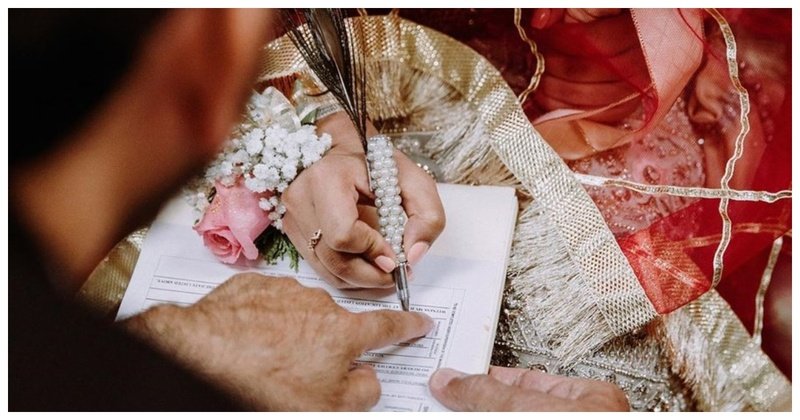
- Nikah Nama: complete all columns, including mehr, conditions, and the delegated right of divorce (column 18) if agreed, and have the parties, witnesses, and Registrar sign.
- Registration: the Registrar enters the marriage in the Union Council register.
- Certificate: the Union Council enters the record in NADRA’s system, and you can then obtain the computerised marriage registration certificate.
Where documents are complete, the Nikah itself usually takes about an hour; registration and the computerised certificate follow the Union Council’s own timeline, which varies.
After the Nikah: Registration, NADRA and Protection
Getting the Marriage Registration Certificate
NADRA does not perform marriages. It issues the computerised certificate from the record the Union Council enters, so the Nikah Nama must be registered first. Keep certified copies of the Nikah Nama; you will need them for the B-Form of children, passports, visas and inheritance.
If the Family Objects
Couples who face threats after their Nikah can seek protection through a petition before the High Court or a Justice of the Peace. A properly documented Nikah, affidavits of free will and the registered Nikah Nama are the strongest evidence in those proceedings.
Marriage Procedures for Other Religions
The procedure on this page applies to Muslim couples. Christian marriages are governed by the Christian Marriage Act 1872, Hindu marriages in Sindh by the Sindh Hindu Marriage Act 2016 and elsewhere by the Hindu Marriage Act 2017, and Sikh marriages in Punjab by the Punjab Sikh Anand Karaj Marriage Act 2018. Each has its own officiant and registration rules.
Interfaith Marriage
Under Muslim personal law as applied in Pakistan, a Muslim man may marry a Christian or Jewish woman, but a Muslim woman’s marriage to a non-Muslim man is not recognised. Interfaith cases always need individual legal advice before any ceremony.
Why Use a Lawyer for Your Nikah?
- We confirm eligibility before the ceremony, so the marriage cannot later be challenged on age, consent or an earlier marriage.
- We arrange a licensed Nikah Registrar and check every Nikah Nama column, including mehr and column 18.
- We prepare affidavits of free will and keep a documented record.
- We handle overseas and foreign-spouse cases, including vakil authority and attestation.
- We follow up registration until the computerised certificate is available.
Our Karachi Office
Visit us at Mezzanine Floor, Muneer Mobile Mall, Block 17, Gulistan-e-Jauhar, Karachi. Please call or WhatsApp +92 333 1127835 before visiting; we will confirm the full location and an appointment time.


Court Marriage in Pakistan: Frequently Asked Questions
Is court marriage legal in Pakistan?
Yes. A Nikah between two consenting adults, solemnised before two witnesses and registered under section 5 of the Muslim Family Laws Ordinance 1961, is fully legal.
Does court marriage take place in a court?
No. The Nikah is performed at a lawyer’s office by a Nikah Registrar. Courts are involved only if a later dispute or protection petition arises.
Can a girl marry without her parents’ permission?
An adult Muslim woman may marry with her own free consent; the Supreme Court upheld this in PLD 2004 SC 219. We still encourage family involvement where it is safe.
What is the minimum age?
18 for both the bride and the groom in Sindh, Islamabad, Punjab and Balochistan. The Registrar verifies age from the CNIC.
How many witnesses are needed?
Two adult Muslim male witnesses, or one man and two women, with their original CNICs.
Is a newspaper notice required?
No. There is no notice period or advertisement for a Muslim Nikah in Pakistan.
How long does it take?
The Nikah usually takes about an hour once documents are complete. Registration and the NADRA certificate follow the Union Council’s timeline.
Can an overseas Pakistani have a court marriage?
Yes, either in person or through a vakil appointed by a specific authority attested by the Pakistani mission abroad.
Can a married man have a court marriage?
Only with the prior written permission of the Arbitration Council under section 6 of the MFLO 1961.
How do we start?
WhatsApp or call +92 333 1127835 with both parties’ details. We will confirm documents, eligibility and an appointment at our Karachi office.
Arrange Your Court Marriage in Pakistan With Confidence
A court marriage is a lawful, dignified way for two adults to marry, provided the Nikah is properly solemnised and registered. Send your names, ages, marital status and city on WhatsApp to +92 333 1127835. Our team will review your case, tell you exactly which documents are missing, and arrange the Nikah, Nikah Nama and registration at our Karachi office.
Related Guides
Official Sources
- Muslim Family Laws Ordinance 1961 — Pakistan Code
- Sindh Child Marriages Restraint Act 2013 — Sindh Laws
- NADRA — Marriage Registration Certificate
This page gives general information about Pakistani law and is not legal advice for your particular case.
Reviewed by: Tahir Pervez Qureshi, Advocate High Court
Published by: Nikah Nama Online Service, Qanoon Group
Last updated: 4 November 2026